A subscription-based compliance platform for the air-cargo industry.
World AVSEC turns the records behind TSA air-cargo compliance into a multi-role application: companies, facilities, employees, training, documents, subscriptions and partner authorisations in one system. WordPress and WooCommerce provide the foundation; the product logic lives in a custom application layer built around the way the supply chain actually works.
Records inside one company. Trust between many companies.
The account area has to do two jobs at once: keep each facility’s compliance evidence current, then expose the right evidence when another business needs to verify and authorise a working relationship.
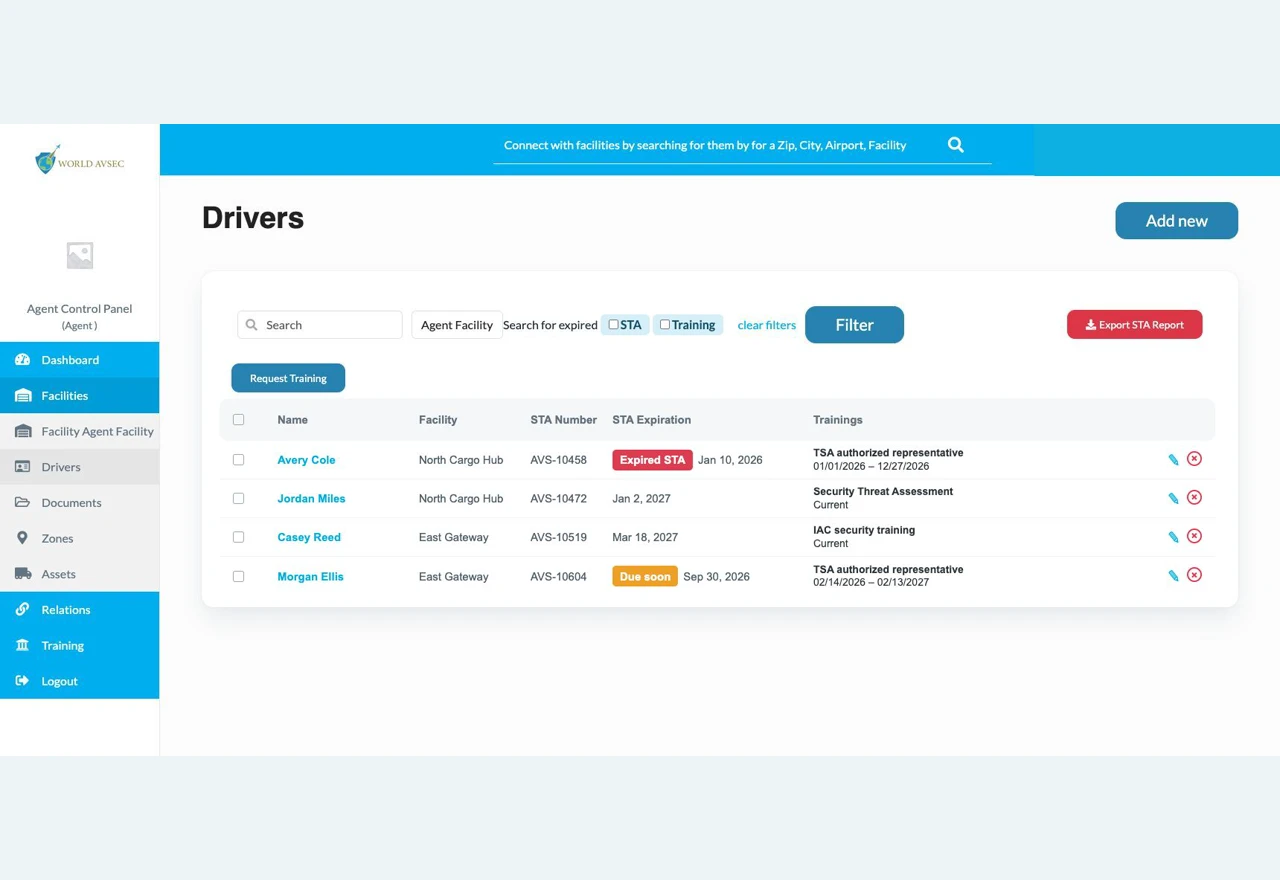
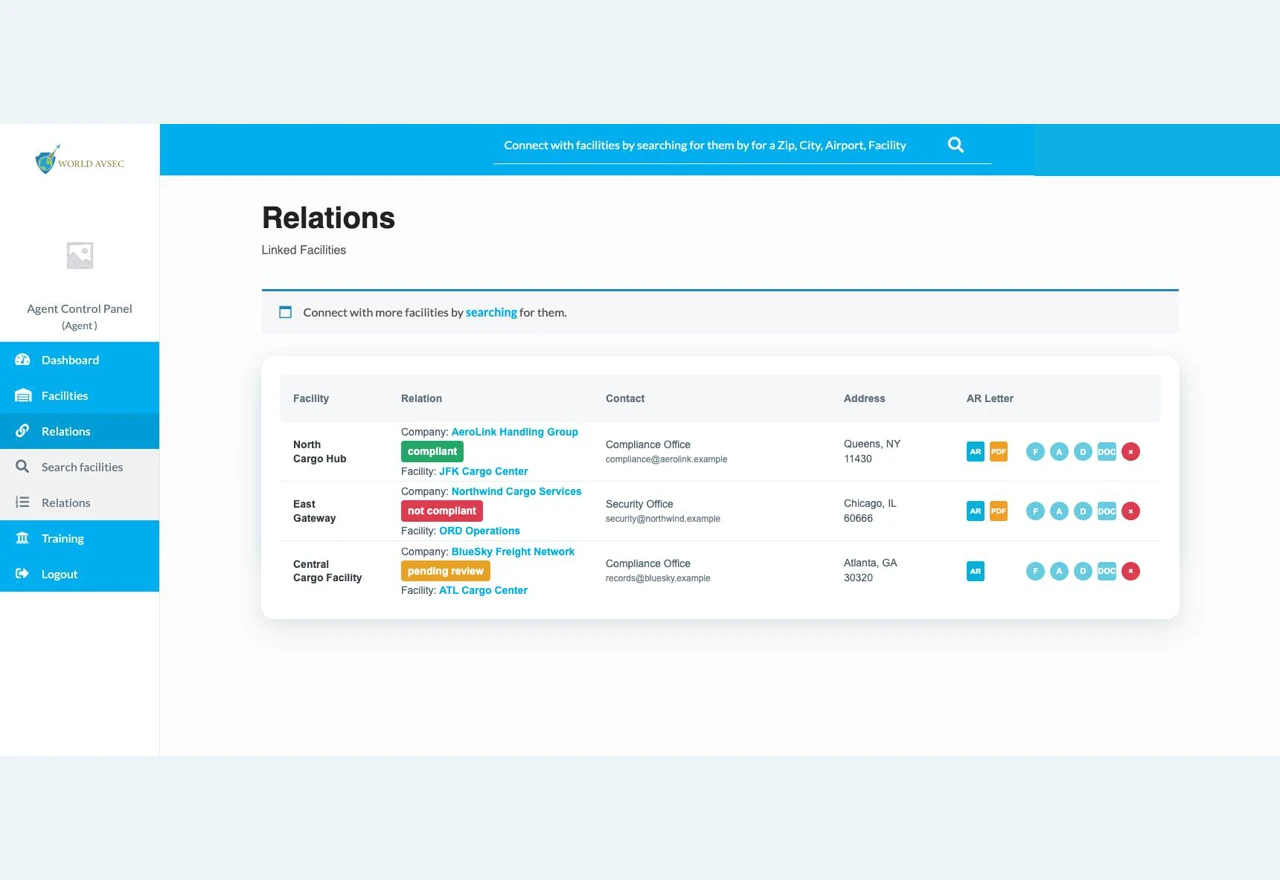
Interface screenshots contain fictional demonstration names, organisations, contact details, addresses and compliance records. No customer or user data is shown.
The compliance data was scattered. The obligation was not.
Air-cargo companies need current records for drivers, security threat assessments, mandatory training, facilities, vehicles, screening equipment and supporting documents. When those records live in spreadsheets, folders and email threads, answering a compliance question becomes a search exercise.
The data is relational. A user belongs to a company; a company can operate several facilities; each facility has its own employees, evidence, assets and subscription state. A flat membership plugin cannot represent that hierarchy safely or clearly.
The supply chain adds a second problem. An Indirect Air Carrier may need to work with an authorised representative in another market. Finding that facility, requesting a connection and exchanging authorisation evidence are part of the same operational workflow as the underlying compliance records.
Four layers turn records into an operating system.
Models the business hierarchy
Role-aware registration creates the user, company and first facility together. From there, each organisation manages its facilities, employees, fleet, airport zones, screening equipment and secure documents in the right context.
Makes billing part of application state
WooCommerce Subscriptions is more than checkout. Company and facility access are gated by subscription status, and status-change hooks activate or deactivate the corresponding facilities without duplicating a second billing system.
Keeps evidence attached to the people and places it describes
Driver records hold STA numbers, status and expiry dates alongside required training and certificates. Teams can filter expired records, request training in bulk and export the current state when it needs to leave the platform.
Connects companies through an explicit workflow
Facilities can be found by location and capability, connection requests can be accepted or rejected, and authorisation letters can be generated as PDFs. Partner access builds on those relationships instead of exposing operational data publicly.
A WordPress codebase organised like a product.
The custom domain plugin separates models, controllers, data stores, enumerations and email classes behind a namespaced autoloader. Business rules have a defined home instead of accumulating in a theme file or a chain of page-builder callbacks.
WooCommerce handles products, orders and recurring payments; the application layer maps those events onto companies and facilities. A custom theme and a partial Vue.js frontend provide the account experience without forcing every screen into a single frontend framework.
Google Places supports structured facility addresses. Secure document handlers keep upload and download permissions inside the platform, while a custom HTML-to-PDF layer turns signed authorisation records into portable evidence.
Where the architecture carries the business rules.
Model the supply chain, not a membership list
Companies, facilities and users are separate entities because ownership, billing, permissions and compliance evidence do not all live at the same level.
Use subscription events as domain events
Payment state has a direct operational consequence. Mapping WooCommerce status changes onto facilities keeps billing and product access in one source of truth.
Give every rule a durable home
The domain plugin keeps models, persistence, workflows and email behaviour explicit, so the platform can evolve without turning the theme into the application.
Building a portal that standard plugins cannot describe?
WordPress can support complex operational products when the data model, permissions, billing events and workflows are designed as one system. That architecture is the work — the interface is only where it becomes visible.