A cleaner, faster foundation for a technical certification business.
EngineCert’s existing site mixed WPBakery pages with newer native WordPress structures, making the frontend slow to change and difficult to keep consistent. The rebuild translates a complete wireframe into a block-native system, gives repeated service content a single source of truth and carries legacy Industry News into a structure designed for continued publishing.
From a mixed frontend to one visual and content system.
The new direction does more than change the palette. Page structure, service content, navigation and editorial components now share a consistent set of patterns that can be reused instead of reconstructed page by page.


Two frontend generations were sharing one website.
The existing site had grown across WPBakery and more recent native WordPress work. The result was not one editable system but overlapping structures, inconsistent presentation and a growing number of content and frontend errors.
A full wireframe defined the new information architecture: core company pages, approximately twenty service and subservice pages, fourteen homepage service cards and a dedicated Industry News section. The aesthetic had to align with a newer sibling site without copying its implementation constraints.
The news archive added migration risk. Legacy articles under /news/ could carry search value, so the rebuild needed a deliberate path into /industry-news/, including redirects and a structure that supports future editorial automation.
Four systems replaced page-by-page maintenance.
One block-native frontend
The wireframe was rebuilt with GeneratePress, GenerateBlocks and a focused custom theme layer. Reusable typography, spacing, buttons, cards, headers and content sections replace the former mix of builder output and one-off markup.
Service content managed once
The fourteen primary service cards are modelled as structured content rather than copied homepage blocks. Thumbnails, descriptions and related page data can be updated centrally and reused across service grids and individual destinations.
Industry News became a real publishing section
Legacy material is mapped into a dedicated news structure with categories, archives, author presentation, related-article components and planned 301 redirects from old URLs. The migration protects useful content without preserving the old frontend.
Automation stops at editorial approval
n8n collects newsletter messages from a dedicated Gmail intake, parses each item, sends the prepared context to Claude and routes the result either to the Industry News post type or to an error-notification path. Publication remains a deliberate decision for the EngineCert team.
Industry News became a product surface. n8n became the preparation layer.
The legacy archive was not simply moved into a new template. It became a focused destination for regulatory analysis, categories, search, industry events and frequently asked questions — all assembled from reusable publishing components.
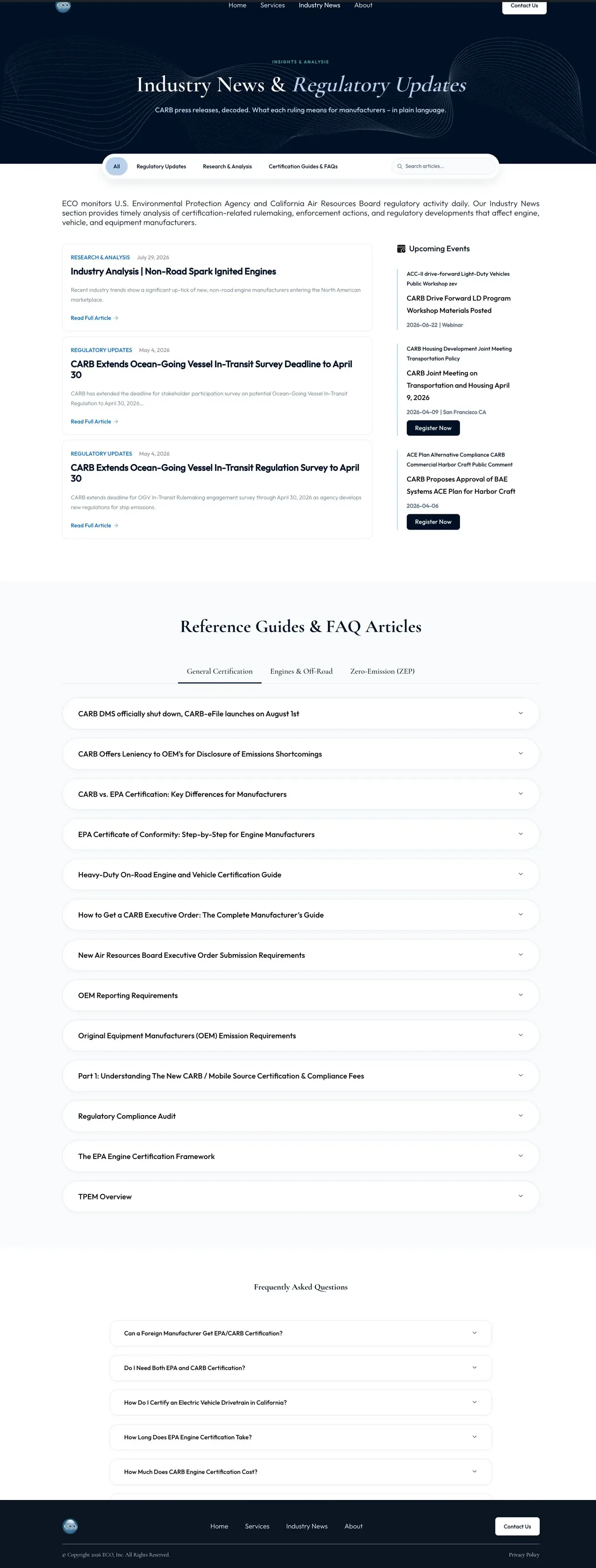
The page brings regulatory updates, research, events and reference material into one structured publishing surface. Taxonomies, query loops and shared cards let new material enter the system without rebuilding the page around every article.
Behind it, a published n8n workflow turns a newsletter inbox into a controlled preparation queue. A Gmail trigger collects messages, a loop handles them one at a time, and dedicated parsing steps extract the useful newsletter content before an AI request is assembled.
Claude returns the contextualised material, which is parsed and checked before n8n sends a structured item to the custom WordPress carb-news endpoint. Failed AI parsing follows a separate Gmail notification branch, so an exception does not disappear silently inside the automation.
The boundary is deliberate: n8n prepares; the EngineCert team decides. Generated content remains unpublished until a reviewer checks the source, technical framing and relevance, then chooses publish or discard. Final payload handling, permissions and failure behaviour remain part of the pre-launch audit.
A rebuild from the wireframe, not a reskin of the old pages.
The site was developed locally, versioned in a private repository and moved through a staging approval process. That kept the live site available while templates, content models and migration rules were tested as a complete system.
GeneratePress supplies the lean theme foundation; GenerateBlocks composes the page and query-loop structures; a custom child theme carries the visual system. A custom functionality plugin owns service and Industry News behaviour that should not be coupled to presentation.
ACF fields keep repeated metadata editable, including service descriptors and author profiles. Shared card components support both services and related news, while the pre-launch pass will check migrated content, redirects, brand consistency and responsive behaviour before the production switch.
The foundation was designed for the next edit, not just launch day.
Centralise what regulations can change
Service labels and descriptions can become outdated. Structured records let the team update that information once instead of finding every copied card.
Automate preparation, not accountability
The content pipeline can collect and contextualise source material, but publication still requires a deliberate human decision from the EngineCert team.
Move URLs with a map, not by accident
Legacy news and renamed services are handled as migration decisions with explicit destinations and redirects, rather than cleanup performed after launch.
Is your website carrying two generations of frontend decisions?
A rebuild is the opportunity to resolve the content model, editing workflow, performance foundation and migration plan together — before another layer is added.